Market update May 1 – 19, 2013

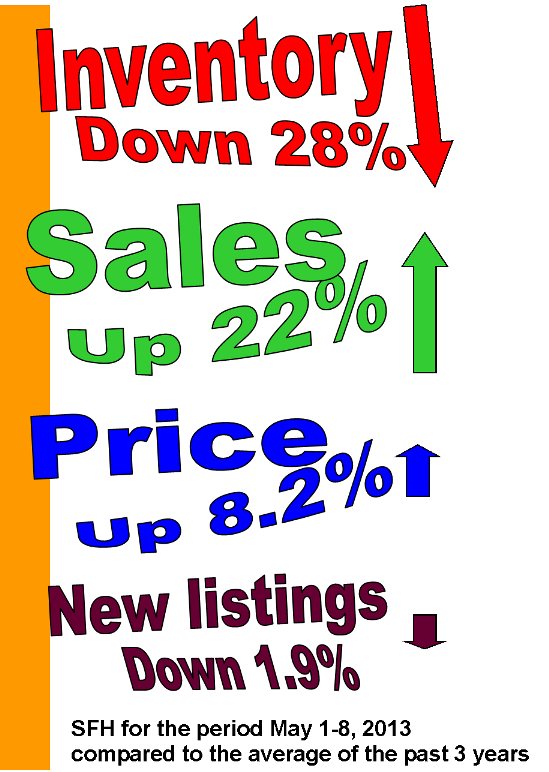
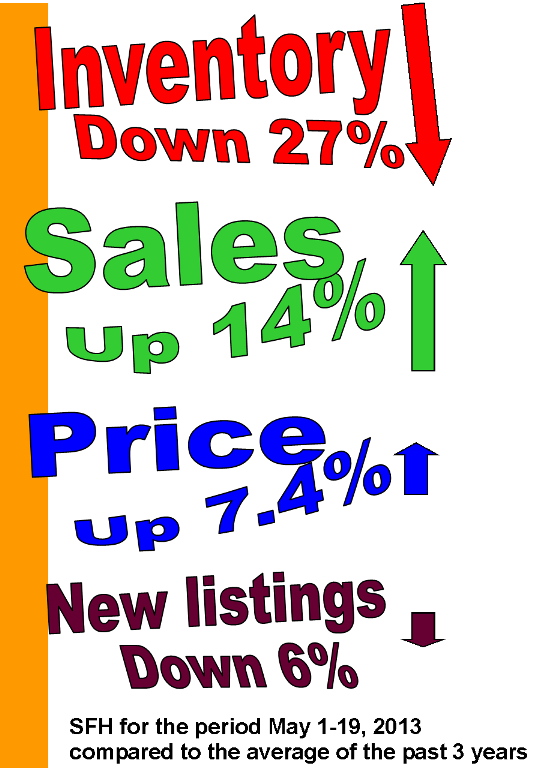
The direct relationship between new listings and sales continues to be evident. In short, when there’s nothing to buy, sales suffer. Sales are only up 14% whereas earlier in the month when they were up 22%, but that can be attributed to low inventory and a lack of attractive new listings.

Inventory vs sales and price2

Some meltdown

Douglas Porter, chief economist with BMO Capital Markets, said evidence  continues to mount that the Canadian housing market seems to have pulled off the  fabled soft landing.

He said surprises on the sales data in recent months have consistently been  on the high side of expectations, not the low side.

“While some are highlighting the fact that prices are now rising at ‘their  slowest pace since the 2009 recession’ the plain facts are that: a) they are  still rising, and b) faster than inflation, and c) prices are at all-time highs.  Some meltdown,” he said

Read more in the Herald:  Calgary a bright light among Canadian housing markets.

Image

Market update May 1 – 8, 2013

Inventory vs sales and price2

Inner-city development properties are in demand right now. A tear-down in Capitol Hill which was listed for $475,000 was sold in one day for $535,000.  An old bungalow on a 50′ lot in Banff Trail sold in one day for $549,900 which was list price. It was purchased in 2009 for $470,000. These homes are usually bought by builders who construct 2 infills in place of one old house.

Bidding wars update: Over the past two days, 20% of sales were for list price or higher.

Insurance against price drops

bpp-ebook-sellyourhomeMortgage broker Greg Williamson has come up with a creative solution to buyers’ fears of a price drop.

The Buyer Protection Plan, launched in January, is designed to protect the buyer for 12 months against a reduction in market value of their home, as the seller places five per cent of the sale proceeds into escrow for a year, guaranteeing market value. If the market falls one to five per cent, then the buyer and seller share the escrow funds proportionally.  If there is no loss in market value, the seller reaps the entire five per cent.

Read more http://bc.ctvnews.ca/buyers-insurance-policy-protects-homeowners-from-price-drops-1.1271390#ixzz2SiwIgACS

What happened in April

A spike in new listings led to a dramatic rise in first-time buyers in April. Bidding wars are at their highest level in years. Over the past 3 days, 24% of homes sold for list price or higher. With new listings up 5%, I would have expected to see a drop in the median price, but the pent-up demand from buyers kept sales and prices up there. When 24% of homes are selling for list price or higher, you can be assured that inventory levels are not making for a healthy market. Let’s hope for a surge in new listings in May. You can see a more comprehensive update on my Monthly stats update.

Inventory vs sales and price

Market update Apr 1 – 25, 2013

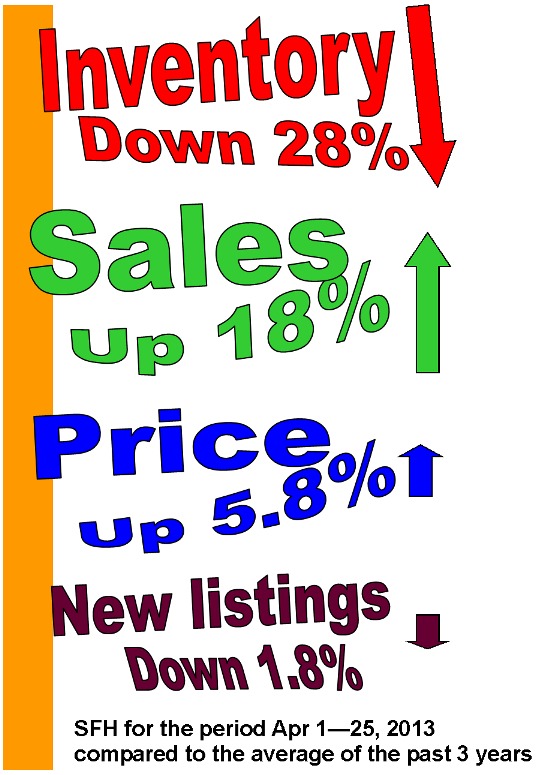
Inventory remains very low for this time of year.

Inventory vs sales and price2

Who should pay for infrastructure?

No doubt you’ve heard about the “Smoking Gun” video of a November meeting hosted by Cal Wenzel, founder of Shane Homes, where Wenzel presents a plan to defeat select members of city council who are perceived to be anti-development.

Some in the housing industry have been clashing with the city over growth and who should be responsible for infrastructure.

Mayor Nenshi, in an interview on CBC this morning, says he is against urban sprawl and corporate welfare, implying that developers, and ultimately new home owners, don’t pay the true costs of their infrastructure, and are getting a free ride on the backs of the taxpayers.

When the city pays for infrastructure, it distorts the playing field.  Rather than making inner-city more attractive because the infrastructure is already there, it basically subsidizes the developers(and their private jets and big profits, as Nenshi pointed out),  and contributes to urban sprawl. Should developers be paying for the true costs of the infrastructure in new areas?

Global News video of Cal Wenzel, founder of Shane Homes, presenting a plan to defeat select members of city council are perceived to be anti-development: http://globalnews.ca/news/502394/exclusive-video-obtained-by-global-news-reveals-calgary-developers-plan-to-control-city-council/

CBC’s Eyeopener this morning: Mayor Nenshi reacts

This story has produced a flurry of comments on Global’s website. For example:

“Things WILL change, they WILL HAVE to build sustainably and buck up with environmental initiatives as well as paying for asp’s that they push the City to develop just because they want to slap up a new development in the sprawling parts of Calgary. Shame shame shame. Well done global, we need more developers actions put under the microscope”

“Continued urban sprawl is a financial subsidy to housing developers in that their developments get the necessary physical infrastructure (water, road, sewer, transit, et cetera) on the cities dime and property taxes never fully recover these costs.   The city carries a large ongoing debt due to the expense of continued urban sprawl that these developers are trying to ensure continues unabated through the purchase of the necessary votes on city council.”

“The fact is that inner city development is far less costly when you look at the overall life cycle costs than development on the fringes (Transportation, water, sewer, etc.) so its time that the full cost of development is borne by the consumers of new homes in the suburbs.”

Garth Turner misleads his readers about Calgary

Do not read

Turner said on his GreaterFool.ca blog: It is different in Calgary. It’s worse. Year/year prices are up a startling 9%, but sales have just turned negative compared to last Spring. SFH sales are down 6%, and listings have crashed 22%…The nation’s most American city risks getting a wee taste of Vegas.

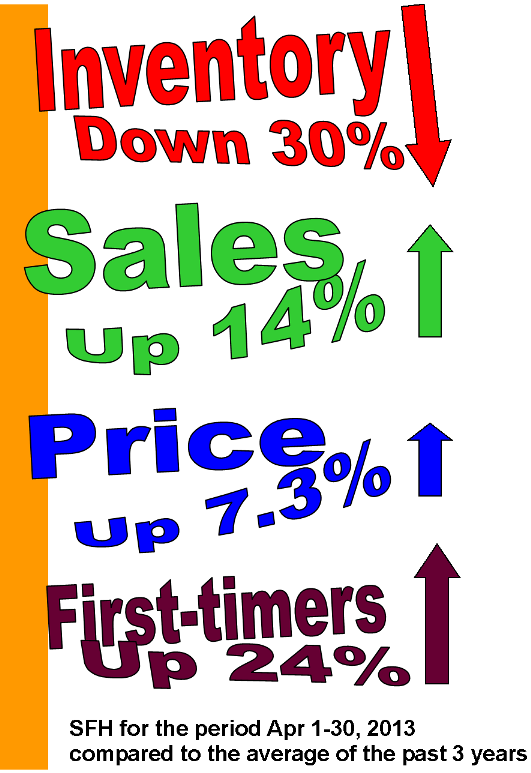
For someone who prides himself on accurate and up-to-date data, this is quite an astonishing deception which he’s trying to pull. How about using data from April? You know, current, updated, relevant numbers?  We know that Gartho has a bookmark to these latest numbers CREB statistics. Sales for the city of Calgary are actually up 14% compared to last year, and new listings have turned the corner this month and are up 13%. It’s no secret that sales have been low because inventory is down 30% compared to historical averages. There just hasn’t been anything to buy.

When you quote statistics that are outdated to prove your point, it makes one wonder if you have an agenda. As it is, GreaterFool.ca seems so intent on having Alberta join the ranks of falling markets in Toronto and Vancouver that he is willing to mislead his readers. Calgary’s stable market has been a source of severe irritation for Turner. Maybe he’s so blinded by his dislike of anything Calgary that he believes his own chicanery and deceptions.

Transparency? Let’s see how forthcoming he is about Calgary’s numbers at the end of the month when sales are up. I predict silence. The greater tragedy, however, is that most of his docile followers don’t even question him.

Market update Apr 1 – 19, 2013

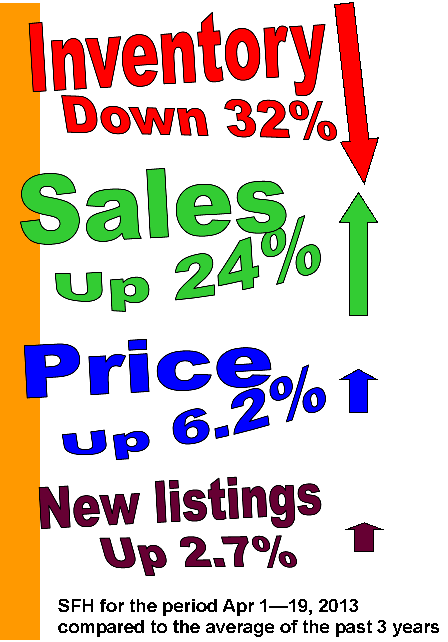
Despite more new listings, inventory continues to drop because of the increased sales.

Inventory vs sales and price2

The demand for homes in Calgary is resulting in numerous bidding wars. Yesterday, 25% of all sales were for list price or higher. A home in Scenic Acres which was listed for $458,000 had an accepted offer after one day on the market and sold for $468,000. It was purchased in 2001 for $209,000.

A tear-down on a 50′ lot in Montgomery also sold in one day. It was listed for $419,000 and sold for $432,500.

2007 is history

Average and median prices in Calgary have been flirting with all-time highs this year. I had a look at the sales history from the past 3 days to see the ultimate fate of those homes sold in 2007 when prices were at their peak.

We’ve had 11 sales where the homes were previously sold in 2007. The average list price was $601,027. The average sale price was $610,136.

7 of the homes sold for more than the previous purchase price in 2007.